reabc/Freedom for Puerto Rican Political Prisoners POWs - ProLIBERTAD/Freedom for Puerto Rican Political Prisoners POWs - ProLIBERTAD.pdf
Web PDF • Imposed PDF• Raw TXT (OCR)
![Today while | write this letter | have been 36 hours without going out and tomrtow if they do nok take us out it will have three days without mov- g from this same space. n this lise space | havetp dorevenyshing. From ulimnwmmhhmundmymsarfliwdmwm Jauine at the same time. My beds a sab of cement, And the whole cell i painted the same dead yellow color From an aesthetic poipt of view itis as atwactive a5 a jal for 200 animas. Intheir 1967 repor, the organization Auesty Intgmational condemned the conditions at Marion saying: 2 In Marion,volations of the Mipimum Standard Rules [of the United Nations for the treatment of prisoners] e common..There is aimost no cule in the Minimum Standard Rules thats,nat in one form or anather. e The 1990 report by the Hause of Represen: atives’Subcomittee on Courtslnieliectual Property and the Administration of Jusiice expresses conceml..) about the amount.of time that the prisoners spend in their cels in relative islation and the limited pppoRunities for productive activity and recieationavaiable, in highly controlied environmeat And the. necessity to“continue developing 3 mare. humane focus for the imprisonment of prison- ers in a maximum secuity prison” From 1986 (o 1988 Alejandrina Torres was _,, putin a Maximum Security Unitfor women in. Cexington, kY Acknowledging the ideological - CalesAlberto Tarras character of the assignment to this unita feder- aljudge stated in Bacaldiol v Meese: One thing i to place persons under greater secuity because they have histories of escape attempts and pose’specialrsks for our correctional faciites.But consigning anyone t0’a high security unitfor past political associations which they will never shed unless forced to renounce them is 2 dangerous mission for this country’s prison system to Continue. ‘Amnesty Iternational concluded in 1988 that the conditions and diet in ths unit were delberately and gratuitously oppressive.” The UNSMRTP states clearly that pisaners should be allowed to communi- cate with their family and friends,including vists, and that‘prison personnel should be responsible for assuring and improvieg fthe relations of] prisoners” with their familis. Federal regulations and the US.Prison Board Rules repeat the same thing (28 CFR Sec.540.40). Nevertheless Oscar Lopez Rivera was not per- mitted any visi that involved physical contact. Some.of the prisoners have to submit t0.2search before and after visits by thei familes even though they only 7](Freedom for Puerto Rican Political Prisoners POWs - ProLIBERTAD 9.png)



FREEDOM
FORTHE
-PUERTO RICAN
'POLITICAL
PRISONERS
~ AND-
~ PRISONERS
ProLIBERTAD Campaign for the Freedom of
Puerto Rican Political Prisoners and Prisoners of War
Pusrio Rlcan Paicl Pritosers moee seinry
served between 10 and 14 yoars In prison.~
What Is ProLIBERTAD?
ProLIBERTAD's goal is the unconditional freedom ‘of all the Puerto Rican politi-
cal prisoners and prisoners of war. The work group is composed of individuals
and organizations who work together on a broad and unitary basis,accepting
diflerences of ideological or political position,but sharing the responsbilty to
support these Puerto Ricans who have been imprisoned for their political activi-
ties in the cause of Puerto Rico's independence and self-determination.
It is our aim to develop an educational campaign sponsoring activities, con-
ferences, publications, and use the press,radio anid television 10 inform the pub-
lic about who the prisoners are,the circumstances of their mprisonment, and
the reasons why a person, whatever his of her political belefs, should demand
their amnesty.
We are aware of the work this entails and see the need to callaborate and
coordinate as much as possible with other organizations and people working
for the unconditional freedom of all the Puerto Rican political prisoners and pris-
‘oners of war, as well with groups working for the freedom of African-American,
Native American, Chicano and White poitical prisoners in the Uned Sajes
Who Are the Puerto Rican-Political Prisoners
and Prisoners of War? i
They are workess and professionas, students
and teachers, community organizers arists, moth-
ers and fathers of families. And they are fighters for
Puerto Rico's independence and soclal justice.
‘“These men and women found Puerto Rico's colo-
nialreality ntolerable and unacceptable.This situa-
tion led them to join the Puerto Rican indepen-
dence movement and to confront the United
States govemment directly. The majorit of the
politcal prisaners have spent more than a decade
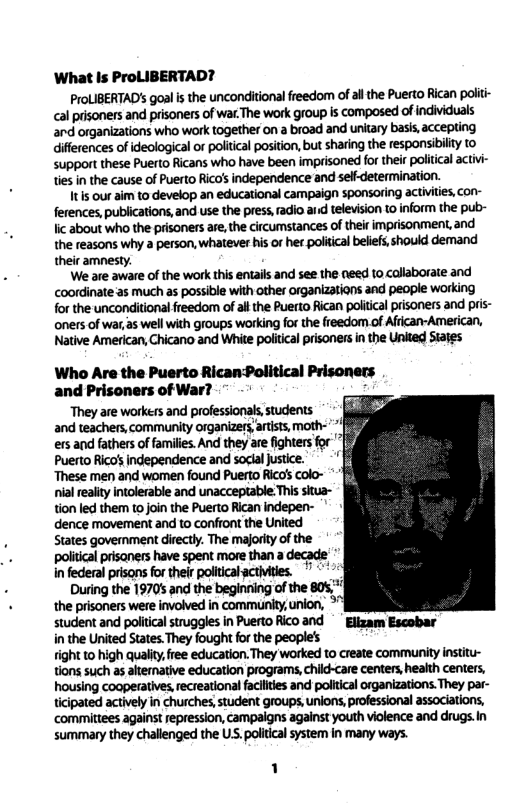
in federal prisons for their politicalacthities. "¢
During the 1970’ and the beginning of the 805,
the prisoners were involved in community,union, >
student and politcal struggles in Puerto Rico and * Ellzam Escobar
in the United States. hey fought for the people’s
right to high quality, free education. They worked to create community institu-
tions such as alternative education programs, child-care centers, heaith centers,
housing cooperatives, recreational facilities and political organizations. They par-
ticipated actively in churches, student groups, unions, professional associations,
‘committees against repression, campalgns against youth violence and drugs.in
summary they challenged the US. poltical system in many ways.
1
‘Throughout their fives they suffered the Puerto Rican colonial realty and the
consequences of thelr political and community involvement. They were fired
from their jobs, icked out of schools and universites, denied scholarships,
threatened, spied on, attacked by the police and the FBL And when they rose u
and fought against these injustices they were branded as terrorists and placed
in some of the worst prisons in the US.
The Puerto Rico’s Colonial Case
Puerto Rico has been a colony for 500 years first of Spain and then of the
United States.In 1898, at the conclusion of what s called the Spanish-Americar
War, Spain was forced to cede the island nation to the United States pursuant 1
a treaty between Spain; France and the United States. No one consulted the
people of Puerto Rico, in violation of a Charter of Autonomy signed by Spain
and Puerto Rico which provided tha the island's status couid ot be altered
‘without consulting the Puerto Rican peopte. The US. military declared martial
law,installed a US.governor,and began a program to
alter and destroy the fiber of Puerto Rico.Over the
‘years, the U.S.destroyed Puerto Rico's agrarian econo-
my; devalued its money; imposed ciizenship on its
people to faclltate trafting its men into the US.army
to fight the U.S. wars;imposed the teaching of the
Engiish language and US. istory on its students; pol-
uted its ai, land, and water;terlized its women;and
installed 21 US. mitary bases on some of the best
Iand. This would sound outrageous and unbelievable,
except that this s the very same US. government tha
exposed unsuspecting ns to radiation, as recent
reports have disclosed.
Puerto Rico's colonial reality cannot be overlooked.
George Bush admitted during his presidency that
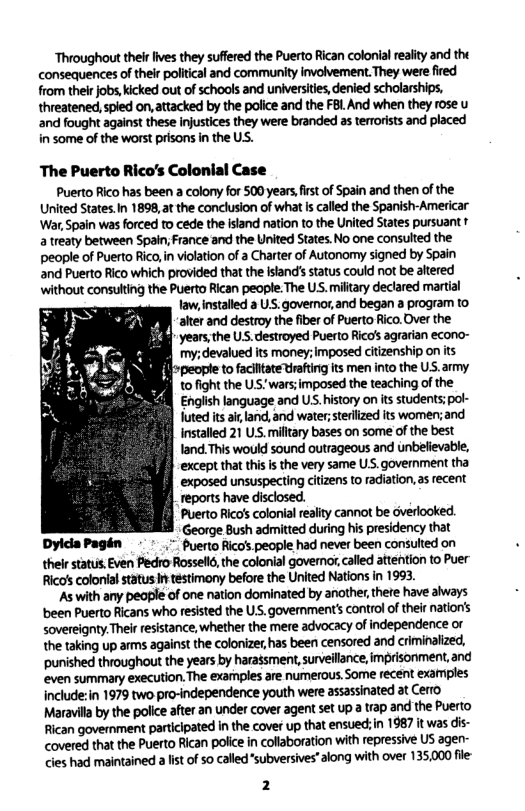
DyldaPagén - " puerto Rico's people had never been consulted on
thelr status. Even Pedro Rosselld, the colonial governor, called attention to Puer
Ricas colonial status it testimony before the United Nations in 1993.
‘As with any peaple of one nation dominated by another, there have aiways
been Puerto Ricans who resisted the US. govermment' control o their nations
sovereignty Their resistance, whether the mere advocacy of independence or
the taking up arms against the colonizer has been censored and criminalized,
punished throughout the years by harassment, surveilance, imprisonment, and
even summary execution.The exarnples are numerous. Some recent examples
include:in 1979 two pro-independence youth were assassinated at Cerro
Maravill by the police ater an under cover agent set up trap and the Puerto
Rican government participated in the cover up. that ensued;in 1987 it was dis-
covered that the Puerto Rican police in collaboration with repressive US agen-
cies had maintained alst of 5o called"subversives"along with over 135,000 fle-
on Puerto Rican citizens for strictly political reasons in clear violation of the
Puerto Rican Constifution;in Sepiembe, 1994 an ex-member of the nteligence
division of the Puesto Bican Police was arrested and accused of (along with
other members of his division) kidnapping, tqturing, and the assassinating the
abor leade, Juan Rafael Caballero in 1977.
Intemational law denounces colonialism a5 a crime and recognizes a colo-
nized peopl’sright 1o end colonialism by any means a their disposal The
United Nations recognizes that these laws apply o the case of Puerto Rico. For
‘many years now, the United Nations' Decolonization Committee has approved
resolutions recognizing the inalienable righi of Puerto Rico's people to indepen-
dence and seli-determination.
“The actions of the Puerto Rican politcal prisoners are comparable to those of
‘George Washington and Thomas Jefferson. Washington and Jefferson
denounced the tyranny of Bitsh control over thei colonies.They fought fo the.
principle of democracy, and gained independence. Similarly, the US government
recognized that Nelson Mandela's imprisonment by the South Afican apartheid
government was unjust. Mandela was jlled for 27 years on chasges of atiempt-
ing to overthiow the apartheid goverment thiough violent means.Like:
‘Washington, Jefferson and Mandela before
them, the Puerto Rican politcal prisoners e
conscientious actvists for freedom and jus-
tice, not criminals. o
The Arrests
1na series of arests carried out between
1980 and 1985 around 30 people were
accused of agting or conspifing 10 overthiow
the authority of the US. government in
Puerto Rico hrough force, in ather words
Ing in favor of Puerto Rico's independence
and self-determination. At the beginning of
the 1980’ fourteen people accused of being ’
declared themseves to be combatants nan-
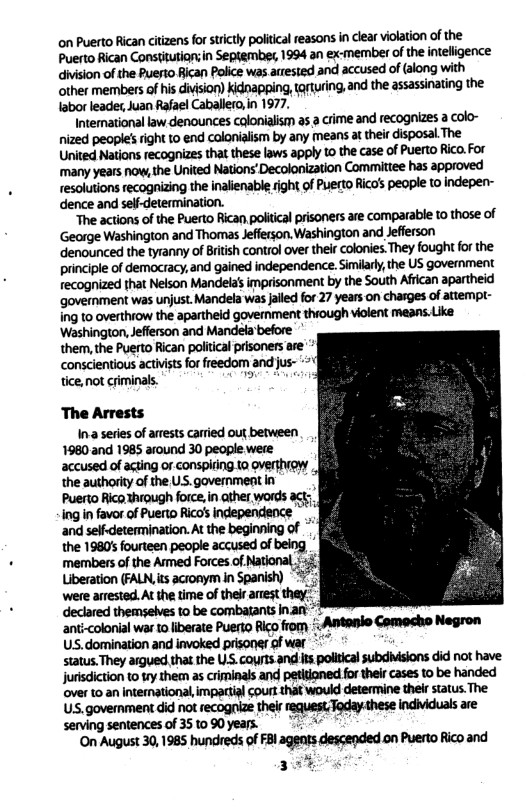
ant-colonial war to liberate Puerto Rico from Antanlo Comacho Negron
US.domination and invoked prisoner of war
status.They argued that the LS. couts.and: s politcal subdbsions did not have
jurisdiction to try them as criminals and petitioned for their cases to be handed
‘over 10 an international, impartial court that would determine their status. The
US.govermment did not recognize their equest.Today.these individuals are
serving sentences of 35090 years. i A
On August 30, 1985 hundreds of FBl agents descended on Puerto Rico and
3%
searched the houses and offces of ndependerce supporters. Thirteen people
were arested that day and three others later on. These people were immediate-
ly removed from Puerto Rico in millary trafisport ahd moved to the United
States where they were held in preventative detention, some for as long as three
years, without bail being set. They weté. aceused of conspiring to rob $7.5 million
from Wels Fargo,an action for which the clandestine group "Los Macheteros™
had taken responsibility.The charges included transporting the money outside
the United States and using the money to buy and distribute toys to poor
Puerto Rican chidren. Of the accused, one was found innocent and the govern-
ment dropped charges against another one.The rest of the accused were sen-
tenced to between 5 to 55 years.Seven of them have already completed their
sentences or are about to complete them.
Punitive Senterices o
“The sentences recelved by these Puerto fican patriots are excessive and
‘punitive. Their goal is to punish political actvty, miltancy,and affiation.Ten of
the fourteen arrested between 1980 and 1983 were sentenced to Serve terms of
between 55 and 90;ears The average sentence among this group is 716 years:
708 years for the ten and 728 years for the women. These sentences are 19
times longer thari the average sentence given out during the year that they
‘were sentenced. The majority are serving the equivalent of a life sentence. O
those that were arrestet s a esult of the Wels Fargo case, two were sentenced
o more than 50 yarsiieson:
- Comimon prisdners;those who cominit critinatoffenses, receive sentences
that are iuch'shortet, Fot example, statisic3fom the federal court system show
that betweeny 1986 11985 the avérage sentence for af those eople found
quilty of murderwas 2.7 years;of rape, 125 gears;of violation of arms laws, 12
years. Only/128%of all federal prisoners have sertences of more than 20 years!
‘Also the statistics show that those people with previous criminal records receive
longer sentences: None of the Puerto Rican patriotsin prison had prior crimi-
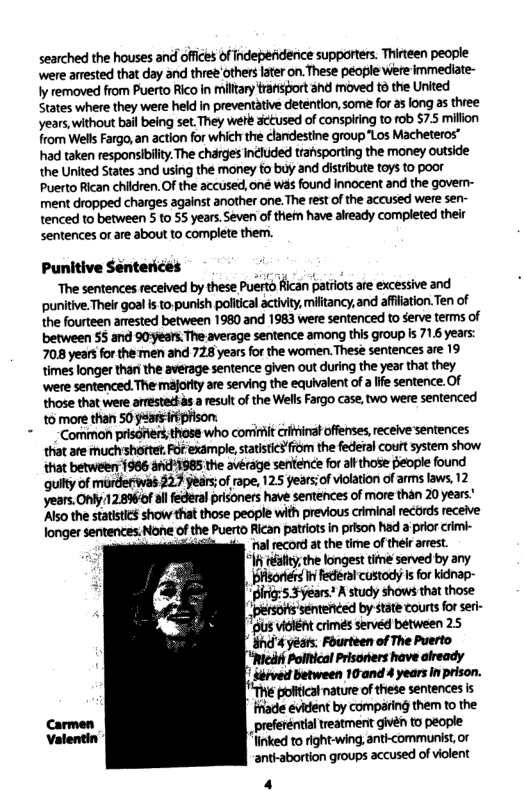
= Tl record at the time of their arest.
16ty the longest time served by any
| i federal custody'sfor kidnap-
" Birig: 5.3 years: A study shows that those
s vclntcrimes served between 25
" Sirved etween 10and 4 years in prison.
poftcal nature of these sentences is
ade evident by comparing them to the
preferéntil treatment givén to people
linked to right-wing, anti-communist, or
anth-abortion groups accused of iolent
4
crimes.For example in 1976 Orlando Letelier, a leader n the movement against
the Pinochet dictatorship in Chile,and his asisiant were assassinated by a
bomb that was placed in Leteliers car which was parked In frontof his sesk-
dence in Washington, DC.The agent of the Chilean secret police who admitted
t0 having placed the bomb was sentenced to 10 yearsin prison,of which he
served 5 years and two months. A major n the Chiean army received a sen-
tence of 7 yearsfor his role in the assassination and a Cuban exile who admitted
his role n the plot received a 12 year sentence.
‘A Ku Kiux Klan Wizard, who was captured in a boat with an arsenal of anms
and explosives while attempting toinvade a Caribbean island with the goal of
establishing a white supremacist state received a
three year sentence and was freed on parole.afer
wo years” Another Kian leader recehved asenencs:
of three years for possession of an arsenal and for
conspiracy. This same man was later sentenced t0.. g
three more years in prison for attempted murder -
and racial harassment after shooting at two black *
men*
Two women anti-abortion actviss sentenced for.
‘conspiring In a series of Florida bombings Including
adoctor’s office and a women's cinic were put.on
probationand received a small fine:Their male co-
conspirators received ten years.n prison and a fine. ;
for three of the explosions,and were not tied for the -Adolfo Matos
fourth explosion. Michael Donald Bray who was
found guilty of bombing ten clincs was sentenced t6 ten years and was set free
after serving 37 years®
“The excessive sentences imposed-on Puerto Rican women and men in prison
because of thelr political activities make i clearthat the goal i 10 punish them
for thei politcal activity and notfor the acts that were alleged by the US. gov-
emment at the time of their arrest.
Human Rights Violations
'Dusing theieimprisonment, the Puerto Rican political prisoners have been
the objects of cruel treatment and degrading and inhumane condition, because:
of their political beliefs This s in direct violation of international norms which
prohibit discriminatoy treatment of prisoners by prison personnel based on
their political beliefs or opinions. [United Nations'Minimum Uniform Rules on
the Treatment of Prisoners (UNSMRTP), Rule A1 6 (1))
Federal regulations stipulate that prisoners should be put n prisons as close
as possible to their homes and families, Nevertheless the Puerto Rican political
prisoners have been kept far from their families and communities in the United
States and/or Puerto Rico. For exampleall those arrested on August 30, 1985 in
Puerto Rico have had o serve their sentences in the United States despite the
existence of a federal prison in Puerto Rico.
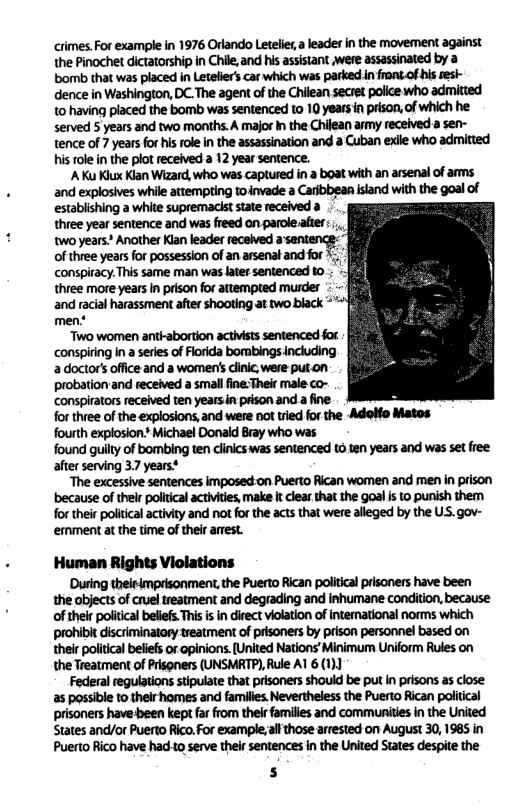
Adolfo Matos s assigned to a prison in Southern
‘Callfornia even though there is a prison very
| close towhere his family ives in New York.
Eltzam Escobar has requested a transfer t0 2
‘prisorvnear to New York to be closer to his son
‘who lives:in New York City. Although hundreds
of prisoners have been assigned to prisons in
;the New York area;Elizam has been denied a
transfecon the grounds of overcrowding.
+Furthen the-politicsl prisoners have been moved
ound continually to difierent maximum secu-
ety:prisons without prior waming to their fami-
attacked by personnel In three difirent prisons.
The st dssauifteidk e when she wasiocked In a men's unit, permitting the
men to exhiblt themselves in front of her Ina second incident a male leutenant
forced her torput her head between his knees and observed while female
‘quardstore offherclothes and lef her nekeck The authortes responded to
Complaints by putting Alejandrina in soltasy confinement, prohibiting from cal-
Ing her family and fawyer to-denounce the sbuses She was penaized for violat-
Ing prison rules, and a secret letter was written to a judge assigned to her case
giving a false version of the events.In anather prison female guards held her
Whie 3 male guard Inserted his fingers in her vagina and her anus during a
“search"The warden who ordered the Searchvadmitted late that he did not sus-
pect Alejatdring of having contraband; and that the search was in violation of
prison rules. ,~
Even though US.law stipulates that pisoners should recelve medical service
equal to that of the standards avalable to the gen-
eral community,the Puerto Rican politcal prisomers:
have been denied adequate medical attention.Fot ..
example,Hayde Beltrén was lefserlle after prison
offcals refused treatment for an nflammation of
the peMis for five years,ignoring episodes of drastic..
‘weight loss and severe pains in her pelvis which.
did not permit her to stand up.: ik
‘Some of the prisoners have been locked inan,,
underground prison with the goal of destioying .-
them physically psychologicaly, and polically.For
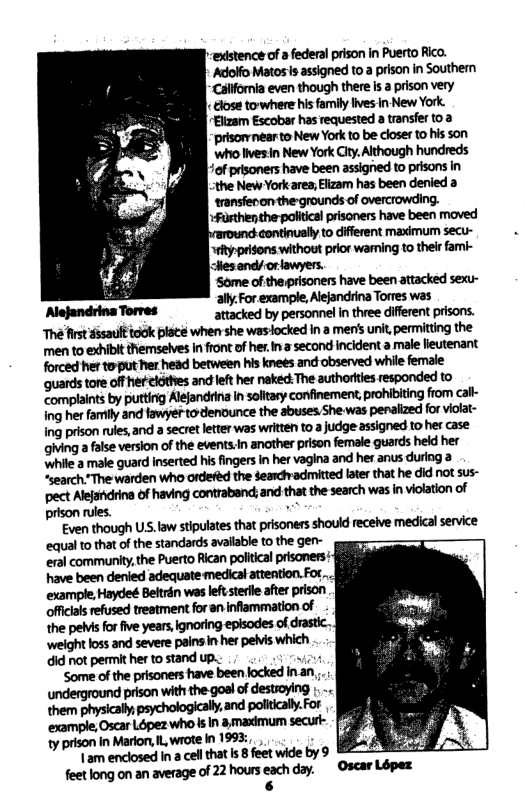
‘example,Oscar Lopez who & In & madmum secut-
ty prison In Marion, I wrote in 1993, , k
| am enclosed In a cell that Is 8 feet wide by 9
feet long on an average of 22 hours each day. Oscar Lopex
6
Today while | write this letter | have been 36 hours without going out and
tomrtow if they do nok take us out it will have three days without mov-
g from this same space. n this lise space | havetp dorevenyshing. From
ulimnwmmhhmundmymsarfliwdmwm
Jauine at the same time. My beds a sab of cement, And the whole cell i
painted the same dead yellow color From an aesthetic poipt of view itis
as atwactive a5 a jal for 200 animas.
Intheir 1967 repor, the organization Auesty Intgmational condemned the
conditions at Marion saying: 2
In Marion,volations of the Mipimum Standard Rules [of the United
Nations for the treatment of prisoners] e
common..There is aimost no cule in the
Minimum Standard Rules thats,nat
in one form or anather. e
The 1990 report by the Hause of Represen:
atives'Subcomittee on Courtslnieliectual
Property and the Administration of Jusiice
expresses conceml..) about the amount.of
time that the prisoners spend in their cels in
relative islation and the limited pppoRunities
for productive activity and recieationavaiable,
in highly controlied environmeat And the.
necessity to“continue developing 3 mare.
humane focus for the imprisonment of prison-
ers in a maximum secuity prison”
From 1986 (o 1988 Alejandrina Torres was _,,
putin a Maximum Security Unitfor women in.
Cexington, kY Acknowledging the ideological - CalesAlberto Tarras
character of the assignment to this unita feder-
aljudge stated in Bacaldiol v Meese:
One thing i to place persons under greater secuity because they have
histories of escape attempts and pose'specialrsks for our correctional
faciites.But consigning anyone t0'a high security unitfor past political
associations which they will never shed unless forced to renounce them is
2 dangerous mission for this country's prison system to Continue.
‘Amnesty Iternational concluded in 1988 that the conditions and diet in ths
unit were delberately and gratuitously oppressive.”
The UNSMRTP states clearly that pisaners should be allowed to communi-
cate with their family and friends,including vists, and that‘prison personnel
should be responsible for assuring and improvieg fthe relations of] prisoners”
with their familis. Federal regulations and the US.Prison Board Rules repeat the
same thing (28 CFR Sec.540.40). Nevertheless Oscar Lopez Rivera was not per-
mitted any visi that involved physical contact. Some.of the prisoners have to
submit t0.2search before and after visits by thei familes even though they only
7
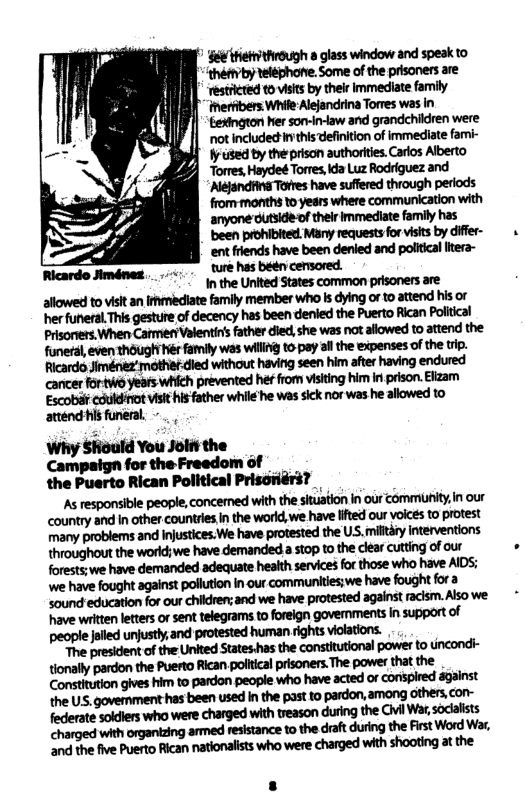
" G5 thettvthrough glass window and speak to
‘théftvbyteléphotie. Some of the prisoners are
Testrcted to visis by thelr Immediate family
merfbers: Whie-Alejandrina Tomres wes in
o Mer son-in-law and grandchildren were
ot includec i ths definition of immediate fom-
JI tyused by the prison authorites. Carios Alberto
Torres, Hayde Torres,da Luz Rodriguez and
" have suffered through periods
from months to years where communication with
anyone outsideof thelr immediate family has
‘been prohibited Many requests for visks by difer-
ent riends have been denied and polical ltera-
Nicerdo Aimdnex. .. ture has béen cerored.
Inthe United States common prisoners are
allowed to visit an Isnmediate family member who s dying or to attend his of
her funeral This gestue of decency has been denled the Puerto Rican Political
Prisoriers, When Carme Valentin's father died, she was not allowed to attend the
funeal, even thougi her family was willig to pay il the expenses of the trip.
Ricardo Jiménezmother:dled without having seen him after having endured
cancer for4wo years which prevented hef from visiing him i prison. Elizam
Escob couldinot visithis father while he was sick nor was he allowed to
anendhis funenal, -,
Why Should You Jolit the
for the Freedom of
the Puerto Rican Political Prisoniérs?
s responsible people, concerned with the situation in our commufity,in our
country and in other countries In the world, we have lited our voices to protest
many problems and Injustices.We have protested the US. miftary Interventions
throughout the world;we have demandeda stop to the dlear cutting of our
forests;we have demanded adequate health services for those who have AIDS;
we have fought against pollution in our communities;we have fought for a
Sound education for our children;and we have protested against racism. Ao we
have written lettes or sent telegrams to foreign govemments n support of
people jalled unjustly,and protested human rights violations.
“The president of the United States has the constitutional power to tincond-
tionally pardon the Puerto Rican polltical prisoners. The power that the
Constitution gives him to pardon people who have acted or conspired dgainst
the UL, govemment has been used in the past to pardon,among athers, con-
federate soldiers who were charged with treason during the Civil W, socialists
charged with organtzing armed resistance to the draft during the First Word War,
‘and the five Puerto Rican nationalists who were charged with shooting a the
Blair House in Washington, DC.in 1950 and at the US.Congress in 1954,
“The time has come for us to publicly denounce the human rights violations
committed against those Puerto Ricans who have struggled for the indepen-
dence of their country and to demand their unconditional amnesty This cam-
paign i based in principles of justce that ae important to allof us:
- Self-determination is a basic right of il people;
+The sentences imposed on the Puerto Rican political prisoners are excessive
and disproportionate;
+The Puerto Rican politcal prisoners
have been the objects of abusive prison
conditions which have violated their hurhan
rights;
+The Puerto Rican poiitcal prisoners.
have served more time than is demanded
of most prisoners,including those who have
been charged with murder.
Now is the time to unite our efforts to
demand their unconditional freedom!
Many voices have cried out for the
release of the Puerto Rican political prison-
ers and prisoners of war already. A few
‘examples of these voices Include:
Petion and thousands o ltters tat da Luz Rodriguez
have been sent to the president and the
attomey general of the United States.
- New Yorks City Council and its former Mayor David Dinkins.
+ Religious groups and individuals who have called for freedom such as the
19th Synod of the United Church of Christ; General Conference of the United
Methodist Church; the Most Rev. Thomas J. Gumbleton, Auxifiary Bishop,
Archdiocese of Detrot;Right Reverend Paul Moore, Episcopal Diocese of New
York Esdras Rodriguez-Diaz Associate General Secretary of the General
Commission on Religion and Race of the United Methodist Church; Cynthia
'Nozomi lkuta, United Church Board of Homeland Ministries; the Ecumenical
Peace Institute/CALC of Berkeley, CA;and the Norther California Ecumenical
Conference of San Francisco, CA.
+Legal and human rights organizations who have caled forfreedom such as
Puerto Rico's Bar Association; the president of the National Lawyers Guild; the
coordinators of the National Conference of Black Lawyers;and Roger Wareham,
Vice-International General Secretary, Interational Assoclation against Torture
About wne Prisoners...
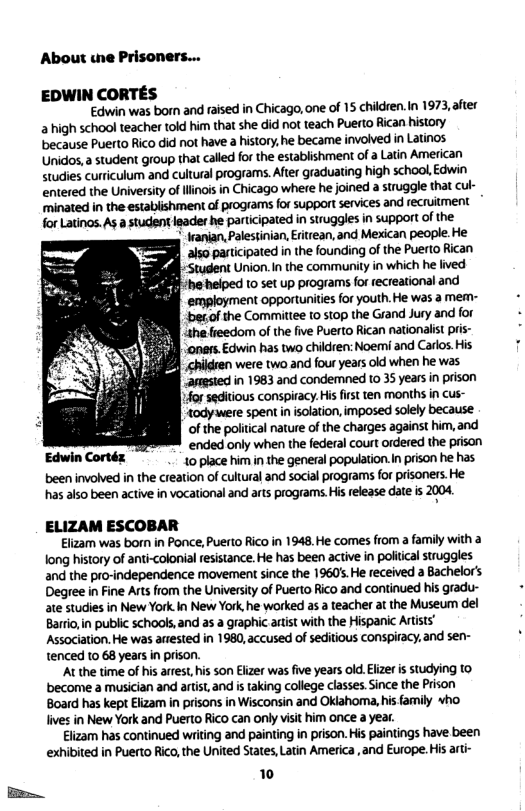
EDWIN CORTES
Edwin was born and raised in Chicago, one of 15 children.n 1973, after
2 high school teacher told him that she did not teach Pueto Rican history
because Puerto Rico did not have a history, he became involved in Latinos
Unidos, a student group that called for the establishment of a Latin American
studies curriculum and cultural programs. After graduating high school, Edwin
entered the University of linois in Chicago where he joined a struggle that cul-
‘minated in the establishment of programs for support services and recruitment
for Latinos.As a studentleader he participated in struggles in support of the
ianian,Palestinian, Eitrean, and Mexican people. He
Ty Rl 2is0 participated in the founding of the Puerto Rican
o= JBglstudent Union. in the community in which he lived
I he helped to set up programs for recreational and
employment opportunities for youth.He was a mem-
begof the Commitiee t0 stop the Grand Jury and for
ihe freedom of the ive Puerto Rican nationalist pris-
‘aners Edwin has two children: Noemi and Carlos His
were two and four years okd when he was
anested in 1983 and condermned 1o 35 years in prison
forseditious conspiracy. His first ten months in cus-
‘todywere spent inisolation, imposed solely because
of the poliica nature of the charges against him, and
‘ended only when the federal court ordered the prison
10 place hm in e general population.In prison he has.
been involved in the creation of cultural and social programs for prisoners.He
has akso been active in vocational and ars programs.Hisrelease date i 2004
ELIZAM ESCOBAR
Elizam was born in Ponce, Puerto Rico in 1948.He comes from a family with a
long history of anti-colonial fesistance. He has been active in politcal struggles
and the pro-independence movement since the 19605 He received a Bachelor's
Degree in Fine Arts from the University of Puerto Rico and continued his gradu-
ate studies in New York In New York he worked as a teacher at the Museum del
Barrio,in public schools,and as a graphic arist with the Hispanic Artists'
Association. He was anested in 1980, accused of seditious conspiracy, and sen-
tenced to 68 years in prison.
At the time of his arrest, his son Elizer was five years old. Elizer s studying to
become a musician and artist,and i taking college classes. Since the Prison
Board has kept Elzam i prisons in Wisconsin and Oklahoma, his family +ho
lives in New York and Puerto Rico can only visit him once a year.
Elizam has continued writing and painting in prison. His paintings have been
exhibited in Puerto Rico, the United States, Latin America, and Europe. His arti-
1
.
les on art and politics have been published in magazines in Canada, England,
raly, Latin America and the United States. He is considered to be one of the most
important Puerto Rican revolutionary painters and poets.Hisrelease date is 2014.
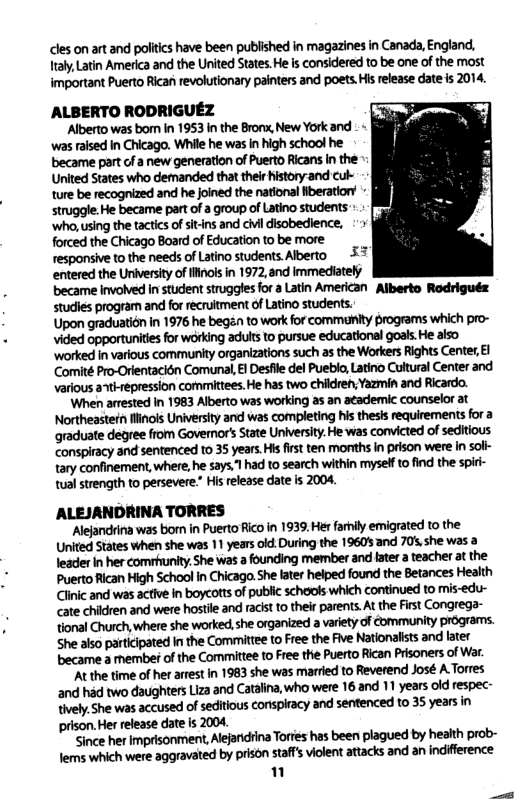
AALBERTO RODRIGUEZ
Alberto was borm In 1953 in the Bronx, New York and . «
was raised in Chicago. While he was n high school he
became part of a new generation of Puerto Ricans In the
Unied States who demanded that theirhistory-and cul-
ture be recognized and he oined the national Nberatiors -
struggle:He became part of group of Latino students .- [
‘who,using the tactics of sitns and civi disobedience,
forced the Chicago Board of Education to be more
responsive to the needs of Latino students. Alberto &
entered the University of ifnols in 1972,and immedately
became involved In student struggles for a Latin American Alberto Rodriguéz
studies program and for recruitment of atino students.
Upon graduation in 1976 he began to work for commanity programs which pro-
vided opportunities for wdrking adultsto pursue educationl goals.He also
‘worked i various community organizations such as the Workers Rights Center £l
Comité Pro-Orlentacién Comunal, i Desfll del Pueblo, Latino Cultural Center and
various a tirepression committees. He has two children,Yazmin and Ricardo.
‘When arrested In 1983 Alberto was working as an a¢ademic counselor at
Northeastefn s University and was completing his thesis requirements for a
graduate degree from Governor's State University. He was convicted of seditious
conspiracy and sentenced to 35 years.His first ten mortths in prison were in soli-
tary confinement,where, he says,lhad t0 search within mysel to find the spi-
tual strength to persevere.” His release date is 2004.
ALEJANDRINA TORRES
Alejandrina was born in Puerto Rico in 1939. Her farnily emigrated to the
WMWM“W!!M*WMM!%WMSMML.
mhmmwmuwmmmamanm
mmmwmmmwwmwmw.mmnn
Clinic and was active in boycotts of public schools which continued to mis-edu-
ate children and were hostle and racst to their parents. At the First Congrega-
IWIMMWMSMWIMGWI\WM.M
She also participated I the Committee o Free the Five Nationalsts and later
m-mmdlmmmmmmmmummdwfl
"At the time of her arrest in 1983 she was married to Reverend José A Torres
and had two daughters Liza and Catalina, who were 16.and 11 years old respec-
mmmmumms:muxymmm;syunln
prison Her release date i 2004
‘Since her Imprisonment, Alejaridiina Tories has been plagued by health prob-
kmsmmemvmledblpmmfllfl‘sMKM‘flfllmm
t0 her medical needs.It took the federal prison system six years to place her in a
regular women's prison. Two of those six years were spent in the underground
‘Women's High Security Unit at Lexington, KY. Amnesty International has con-
demned the conditions in that unit as ‘deliberately and gratuitously oppressive”
and as causing physical and psychological deterioration.
Throughout her more than ten years of imprisonment she has maintained a
positive atttude and works with prisoners assisting them in achieving educa-
tional, vocational,and religious goals.Her faith in God and in her people has
‘maintained her high spirits.In the darkest place they put me n,| aways man-
age to see a glimmer of hope.Taking on the struggle for justice is a matter of
the heart and the conscience. she recently tod the editor of the United Church
of Chst national newslefter.
RICARDO JIMENEZ
“Ricardo was bom in Puerto Rico in 1956, His family moved to the US. when he
was stll an infant. He attended Tuley High School in Chicago when the school
was in the midst of a ciss brqught about by a racist principal and the lack of a
relevant curriculum for Puerto Rican students. As a member of Aspira and the
student council he was a leader in struggles which ultimately led to the creation
of the Roberto Clemente High School.Ricardo was also Vice President of the
Senior Class, a member of the national Honor Society and in 1974 was chosen by
the mayor as the ity of Chicago's Senior High School Student of the Year.
In his community Ricardo worked as a volunteer at El Rancor,a drug rehabiii-
tation Center, and on project on housing which led to the exposure of a plan
called the Chicago 21 plan, to turn the Puerto Rican community into an enclave
for the high income professional class. Upon graduation he attended Loyola
University and was a member of the Latin American Student Organization,
which developed the university’ first Puerto Rican history class. He later attend-
d llinois Institute of Technology in Chicago and was selected to represent the
student body in a national conference on the need to force large US. corpora-
tions to open their doars to Latino engineers and other high tech professionals.
Ricardo was arrested in 1980, accused of seditious conspiracy and related
charges, and sentenced to 98 years.In prison, he gravitated to educational pro-
‘grams, both as a student and as a wtor for other students.He has volunteered
teaching ilierate and functionally literate prisoners to read and write.
CARMEN VALENTIN
‘Carmen was bom in Puerto Rico n 1946 and emigrated with her family to
the US.when she was 10 years old She received a BA.from Northeastern linois
University,a MA from Roosevelt University, and at the time of her arrest was
‘completing her Doctorate from the Universty Carmen became active in the
community as 2 young teacher at Tuley High School, where she struggled
‘against racism and an educational curriculum based on ignorance of the Puerto
Rican realit,outright lies and distortions.She took her role as educator seriously
and refused to compromise her principis with the Board of Education’s
2
demands that she ignore the colonial plight of her people. Her educational pre-
sentations became controversial, and she was forced to resign.
Carmen then began to work at the Central YMCA Community College.
Carmen sponsored both the lranian Student Association and the Organization
of Arab Students during an intense period of struggle and controversy which
led to many physical confrontations with the local police a5 well 25 with the
Shahs secret police.In the community she worked to defeat the infamous Chic-
3g0 21 Plan.She was a founding member and president of the José de Diego
Bilingual Center and was on the board of directors of Aspia of linois. Carmen
was also a founding member of the Ruiz-Belvis Educational Center and develop-
ed various educational and cultural programs for the maximurn security prison
for men at Statevill, L In 1980 she was arested, charged with seditious conspir-
acy and related charges,and sentenced to 98 years.Her release date s 2043.
Her son, Antonio, who was 10 years old at the time of Carmen's arrest, has
graduated from college and works in the same school where his mother taught.
Carmen has a three year old grandchild.
CARLOS ALBERTO TORRES
Carlos was born in Puerto Rico in 1952 His family soon thereafter emigrated
t0 New York and then to Chicago. Carios grew up in his father’s house, a minister
with a passion for soclal justice. His step-mothe is Alejandrina Torres. In his
Junior year in high school he was able to participate in his first Puerto Rican his-
tory class,offered by Aspira. He studied sociology at Southern Ifinois University
‘and later at the University of llinois at Chicago. At the University of linois he:
became involved in the struggles against the racit teachings of Schockley,
Citteneden and other sociologists,as wellas for Latino recruitment (o the uni-
Versity. Carls was Involved in issues n the community related to police brutaliy,
slum landlords, corrupt politicians,and the colonial case of Puerto Rico.In 1980
he was arrested and charged with seditious conspiracy and related charges, and
Sentences to 78 years in prison. His release date is 2024.
‘Upon his arrest,his three year old daughter was hidden for her safety for fear
that government agents would carry out threats to do her harm. n prison he has
worked for many years as a baker,attended college,
and taught Spanish to fellow prisoners. .
JUAN SEGARRA PALMER
Juan was born in Puerto Rico in 1950.He comes |
from a family with a long history of resistance to
both Spanish and U, colonialism. He graduated |
from Harvard University and continued studying in
Cuernavaca, Mexico, He is marred to ex-political
prisoner Lucy Berrios and has five children: Amficat
Ramén, Wendy, Luriza, and Zulena.
During his youth Juan did cultural work n the
poor barrios of New York in the prisons in Boston,
i}
a. l¢ .uming crusades and the land rescue movement in Puerto Rico.
In 1965 1 was arrested for Conspiring t0"overthrow the US. government in
Puerto Rico"and 1o obfain money from the Well Fargo company, insured by the
United States government, o continue the independence struggle in Puerto
Rico.He i serving a 60 year sentence in Atlanta, GA.
ANTONIO CAMACHO NEGRON
‘Antonio was born in Yauco, Puerto Rico in 1945. Antonio, whose family has for
generations lived in the coffee-growing region of Yauco,was a farmer. He akso
Studied psychology at the University of Puerto Rico and two years of law at the
Interamericana University. He worked as a therapist with the Department of
Services against Addiction, Methadone Program. At the time of his ariest in 1986
he was working as a mechanic and was the sole source of income for his family.
He was sentenced to 15 years for allegedly participating in a conspiracy in gen
eral and interstate transportation of money in the robbery of the Wells Fargo
Company in Hartford, Connecticut. Antonio has four children,three boys and
gir,who live in Puerto Rico. He s incarcerated in Pennsylvania, thousands of
miles away from his children and family.
LUISROSA
Luis was bor n Chicago in 1960.At the time of
his artest he was 19 years old and was a young
father and a university student He was aso an excel-
lent baseball player, recruited by professional teams.
At the University of linois he became involved in
the student movement and was president of the
Union for Puerto Rican Students.in the community
he was particulary involved in the struggle against
police brutality: Luis was involved in the campaign
against police murders of unarmed Puerto Ricans
‘which arose in response to the killngs of Cruz and
Osorio in Humboldt Park in 1977 by the Chicago
police.He was an organizer for the Desfile del Pueblo Luis Rosa
Puertorriqueno and at the Puerto Rican Cultural
Center.In 1984 he was amested,charged with sediitious conspiracy and related
charges, and s.tenced to 105 years.
In prison Luis has kept a youthful and enthusiastic sprt. He has continued to
be involved in sportsegucational and cultural actvities. His spotess record has
not prevented the siate system from shutting him merciessly between maxi-
‘mum security prsons, o from one cell 1o another within a prison, or from mit-
Ing hs access 1o educational and other programs available 10 other prisoners.
(OSCARLOPEZ RIVERA
Oscar was bor in-Puerto Rico in 1943. His family moved to the US. when he
‘was nine years old. He was drafted into the army and served in Viet Nam and
“
awarded the Bronze Star. When he returned from the war in 1967, he found that
drugs,unemployment, housing, health care and education n the Puerto Rican
community had reached dire levels and immediately set to work organizing to
improve the quality oflfe for his people. Oscar worked in the creation of both
the Puerto Rican High School and the Puerto Rican Cultural Center. He was
involved in the struggle for bilingual education in public schools and to force
‘universities to actively recruit Latino students, staff, and faculty.He also worked
on ending discrimination in public utiites fike Hlinois Bel, People’s Gas, and
Commonwealth Edison. He was arrested in 1981 and sentenced to 55 years for
seditious conspiracy.In 1988 he was given an additional 5 years for conspiracy
to escape. Oscar is in prison in the maximur securityjail in Marion, linois under
oppressive conditions. Hi release date is 2021.
DYLCIA PAGAN
Dylcia was born in New York in 1946, At an early age she became involved in
the civil rights movement, participating in vote registration drives As a student
3t Brookiyn College she helped organize the Puerto Rican Student Union which
resulted in the formulation of a student-controlled Puerto Rican Studies
Department. By the early 1970', she began a career s a TV producer and wr
developing nvestigative documentaries and children’s programs at NBC. ABK
€8S, and PBS. She worked with the Puerto Rican Media and Education Council,
which filed a series of lawsuits against the major television stations which facili-
tated the local public affairs programming that still exists today. She also worked
s the English editor of the bilingual daily, El Tiempo.
Dylcia was arrested in 1980 and charged with seditious conspiracy and relat-
ed charges and sentenced to 63 years. When she was arrested in 1980, her
young child, whose safety she feared for, was hidden from the government. in
the prison she has developed educational and cultural programs for the other
inmates, has taught aerobics, directed theatrical performances,and organized
camivals for Children's Day.
'ADOLFO MATOS
‘Adolfo was born in Puerto Rico in 1950.At the age of 15, he moved from his
native Lajas to New York City to live with his grandparents. He has two daugh-
ters,Rosa Maria and Lydia.He was arrested in 1980 and Is serving a 78 year sen-
tence for conspiracy and related charges. His famil lives in New York and Puerto
Rico and rarely can afford the expenses of viiting him in California, where he
has been held over the last few years.He has become an artisan in prison, pro-
ducing copper etchings of Puerto Rican scenery and historical figures.
ALICIA RODRIGUEZ
Alicia was born in Chicago in 1953, the frst in her family to be born in the
United States.On entering school,Alcia quickly discovered that being born in
the USS. brought her no privileges, as her Puerto Ricai parents,heritage, lan-
guage,and citure were regarded as foreign, different and ugly by her teachers
5
and fellow students. Her first trip to Puerto Rico, which came only after graduat-
ing high school, was a turning point in her life.On her third and last trip, as a
biology student at the University of Ilinois in Chicago, Alicia was heartbroken to
see the devasiating effects of industrial pollution on the island and resolved to
combat the 00t of the problem -colonialism. She was arrested in 1980, convict-
ed of seditious conspiracy and related charges, and sentenced Lo 85 years in
prison. Her sister is Ida Luz Rodriguez Although she s one of the longest held
prisoners in the prison, with an immaculate record which includes the accumu-
lation of a bachelors degree with honors,after 13 years she is not permitted to
‘walk unescorted across the grounds.
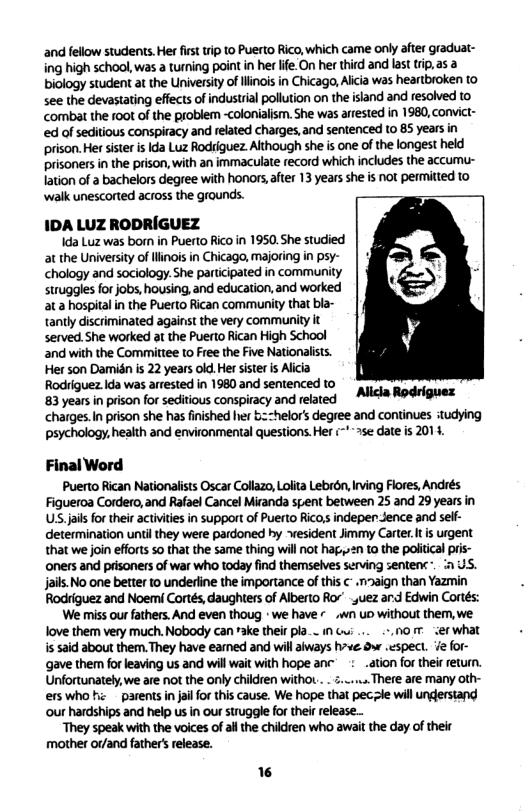
IDA LUZ RODRIGUEZ
Ida Luz was born in Puerto Rico in 1950. She studied
at the University of linois in Chicago, majoring in psy-
chology and sociology. She participated in community
struggles for jobs, housing, and education, and worked
at a hospital in the Puerto Rican community that bla-
tantly discriminated against the very community it
served. She worked at the Puerto Rican High School
and with the Committee 1o Free the Five Nationalists.
Her son Damidn is 22 years old. Her sister is Alicia
Rodriguez Ida was arrested in 1980 and sentenced to
83 years in prison for seditious conspiracy and related
charges.In prison she has finished her bz=helors degree and continues itudying
psychology, health and environmental questions. Her ('~ se date is 2014,
Final Word
Puerto Rican Nationalists Oscar Collazo, Lolita Lebron, ving Flores, Andrés
Figueroa Cordero, and Rafael Cancel Miranda spent between 25 and 29 years in
US.jis for their activiies in support of Puerto Ricos indeper Jence and self-
determination until they were pardoned hy esident Jimmy Carter.t is urgent
that we join efforts 50 that the same thing will not hag,»2n to the political prs-
‘oners and prisoners of war who today find themselves serving sentens . i US.
jails.No one better to underine the importance of this ¢ .n2aign than Yazmin
Rodriguez and Noemi Cortés, daughters of Alberto Ror' uez ard Edwin Cortés:
We miss our fathers. And even thoug * we have « .wn o without them, we
Alicla Rodriguex
Tove them very miuch. Nobody can rake their pla_- it G ... -, . er what
s said about them. They have eamed and will aways hve 9w .espect. e for-
‘gave them for leaving us and will wait with hope anc: ation for their eturn.
Unfortunately we are not the only children withoL ... ... There are many oth-
erswhoh: parents in jail for this cause. We hope that pecile will undersiand
‘our hardships and help us in ou struggle for thei release..
‘They speak with the voices of allthe children who await the day of their
mother or/and father’ release.
WHAJ CAN YOU DO?
130indSEIBERTAD.
I:E:I“ PrOLIBERTAD Committee in your community,church of work-
- ~
te in activities in support of the prisoners; irite to President and
ton demanding theirfreedom; sign petitions demanding their
k! ask friends and family members to do the same.
inige activities, conferences, or panel discussions on the prisoners in
your cBmmunity, church,school,or workplace.
5. Write articles o letters to newspapers, magazines, local bulletins, etc.o if
you know somebody of have 3 relationship with a publication interested
in publishing an article on this theme, communicate with ProLibertad and
someone from our work group will write an artcle.
6.5upport ProLIBERTAD with money.Wite a check to USPRSN (ProLIBERTAD
Campaign), Mail to ProLIBERTAD, PO Box 477, New York, NY 10159-0477
7.Write or call ProLIBERTAD:
New York: ProLIBERTAD PO Box 477, New York, NY 10159-0477
Telephone:(718) 601-4751 Fax {718) 601-3909.
Boston, MA: Latinos por el Cambio Social c/o Central America Education
Fund, 1151 Massachusetts Ave, Cambridge, MA 02130.Telephone: (617) 492-
0699,
Amherst, MA: Max Duefas, 10 Hollister Apts, Hadley Rd, Amherst, MA 01002
Telephone: (413) 256-4578.
‘Washington, DC: Comité Independentista Puertorriquefio del Area de
‘Washington. Contacts:José Vargas: (703) 243-4969 or Nitza Sequi:
(202) 265-9678
1 e ikimation conained in 4 document v been ken o dferensbrochuses s s ncking
e ot by e, Ofensiv 3. the Notonal Comitie o the Freedom of the Polica rioners
e apers o e the Aben Rdiguet SupportCommitee Qe Ondee S0, Clridod and th Puero Ao
Updat.ewsletir of th US/Puero o oidary Network
2 Feerol e of P 198 State o the Ssen ofPsons (Washingion 0109 54
31,0955
s gty Time Wiy the et Goes 0161 the igh Goes Home: The Vage ke, Decemter
0
5 Pl vaering W Kl Leades Gts 36 Months i Weapns Case: The Washgion Pos. 1057891 K e
K LeaderSenenced: Tne Washigion Pos, 0//085.
6 avor AvonionFederation Aniaboron Vidence incdents of Arions, Bombings and A 19771985,
019801 pgs .1 05
el erid B D M Crm 185 082 Tiomcreof evencing e,y 219851 19,50 A
sy f1om o Bch 1 PG A he Washegion Pos by 261989
7
Aludtin
archist Bk
Cott-
ABC s
vy
Dyicia Pagén
188971-024
FCl Pleasanton, 5701 Bih Sueet
Camp Parks, Dublin, CA 94568
\da Luz Rodriguez
188973024
FCl Pleasanton, 5701 8th Street
Camp Parks, Dublin, CA 94568
Carmen Valentin
#88974-024
FCI Pleasanton, 5701 8th Street
Camp Parks, Dublin, CA 94568
Antonio Camacho-Negrén
#03587-069
US. Penitentiary Allenwood
White Deer, PA 17887
Edwin Cortés
92153-024
Unit 3
PO Box 33, Terre Haute, IN 47808
Elizam Escobar
188969024
PO Box 1500, FCI Colorado Two
ElReno, 0K 73036
Alejandrina Torres
192152024
FCl Danbury, Pembroke Station
Danbury, CT 06811
‘Adolfo Matos Antonglorgl
188968024
3901 Klein Bivd. (Unit J)
Lompoc,CA 93436
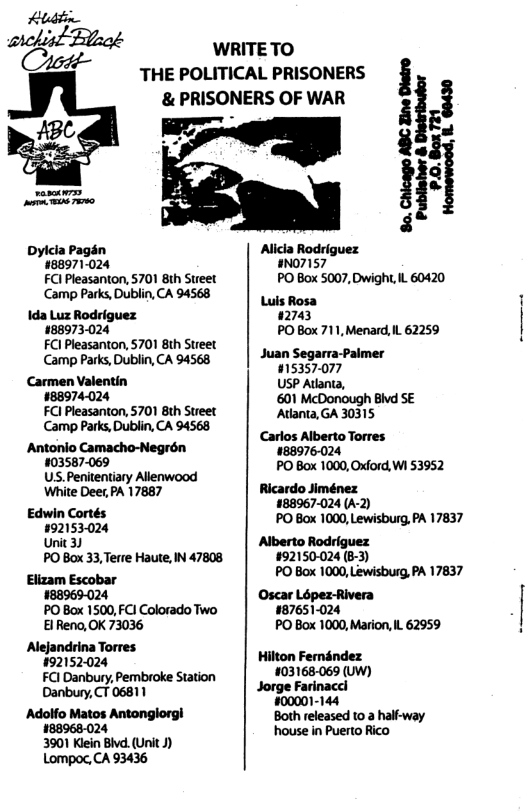
& PRISONERS OF WAR ‘
WRITETO
THE POLITICAL PRISONERS i
iE
Alicla Rodriguez
#NO7157
PO Box 5007, Dwight, IL 60420
Luis Rosa
12743
PO Box 711, Menard, IL 62259
Juan Segarra-Paimer
015357077
USP Atlania,
601 McDonough Bivd SE
Adanta, GA 30315
Carlos Alberto Torres
183976024
PO Box 1000, Oxford, W1 53952
Ricardo Jiménez
188967-024 (A-2)
PO Box 1000, Lewisburg, PA 17837
Alberto Rodriguez
92150-024 (B-3)
PO Box 1000, Lewisburg, PA 17837
Oscar Lopez-Rivera
187651024
PO Box 1000, Marion, IL 62959
Hilton Femandez
03168-069 (UW)
Jorge Farinacci
#00001-144
Both released 0 2 half-way
house in Puerto Rico